 English
Which industries commonly use orthogonal compound machines?
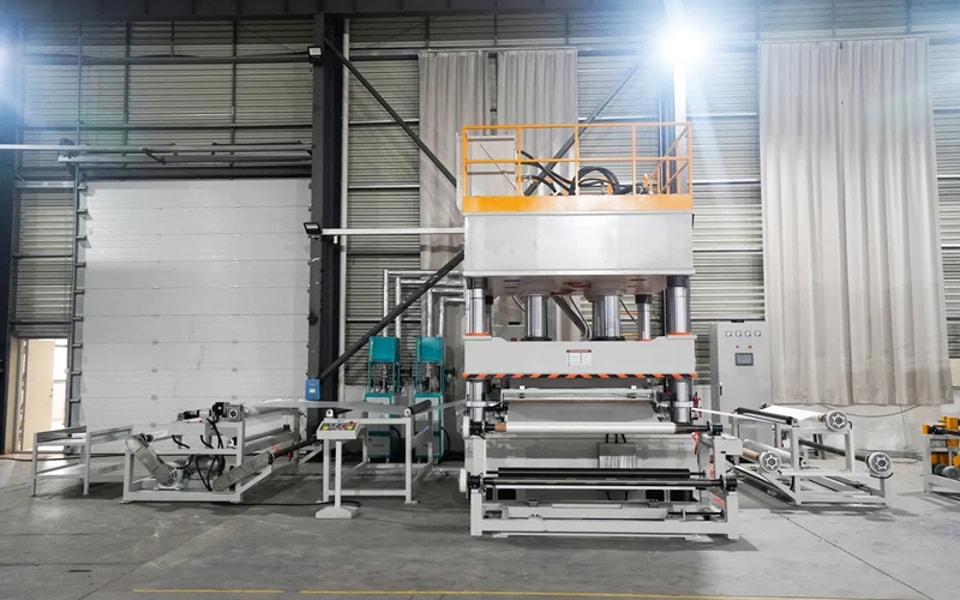
An orthogonal composite machine is specialized equipment designed to lay up and bond high-performance fibers, fabrics, non-wovens, and other reinforcing materials in an orthogonal (crisscross) pattern. By creating a stable orthogonal structure, the material's strength, stiffness, impact resistance, and dimensional stability are significantly enhanced, making the technology widely applicable across various industrial sectors. With the rapid advancement of high-performance composites, orthogonal composite machines have become essential equipment for producing high-quality composite materials in many industries.
First, the aerospace industry is a key application area for orthogonal composite machines. Aerospace products demand exceptional standards regarding material weight, strength, and reliability, necessitating the use of lightweight, high-strength composites. These machines enable the precise placement of high-performance fibers in multiple directions, endowing the composite material with superior load-bearing capabilities across various axes. This improves the overall performance of aircraft structural components, spacecraft parts, and other critical assemblies, while simultaneously achieving goals such as weight reduction, increased fuel efficiency, and enhanced safety.
The automotive manufacturing industry is another major sector utilizing orthogonal composite machines. Driven by the trend toward vehicle lightweighting, high-performance composites are increasingly replacing traditional metals in the production of components such as body structures, doors, chassis, roofs, and interior parts. Reinforcing materials produced via the orthogonal composite process offer not only high strength and rigidity but also effective impact energy absorption, thereby improving vehicle safety. Furthermore, the reduced material weight helps lower overall energy consumption and extends the driving range of new energy vehicles.
Orthogonal composite machines also play a vital role in the manufacture of protective equipment. When materials such as high-performance polyethylene fibers and aramid fibers undergo orthogonal compounding, they form structures with more uniform load distribution and enhanced resistance to impact and puncture. Consequently, they are widely used to produce protective plates, helmets, shields, and other high-strength protective gear. Such products require a balance of high protective performance and low weight for user comfort—requirements that the orthogonal composite process effectively meets.
Marine engineering and shipbuilding industries also make extensive use of orthogonal composite materials. Given the harsh marine environment—characterized by high humidity, salt spray, and prolonged loading—materials must possess exceptional corrosion resistance and structural strength. Orthogonal composite manufacturing machines are capable of processing glass fiber, carbon fiber, and other reinforcing materials to produce hull structures, decks, cabin bulkheads, and components for marine engineering equipment. These machines enhance the products' corrosion resistance, fatigue resistance, and overall service life while simultaneously reducing maintenance costs.
The construction industry is another key application area for orthogonal composite machines. Modern architecture increasingly utilizes fiber-reinforced composites for structural reinforcement, thermal insulation, and decorative purposes. The orthogonal composite process improves the materials' tensile strength, crack resistance, and durability, making them suitable for applications such as bridge reinforcement, building facades, roofing structures, and the construction of large-scale public facilities. Furthermore, these composites offer advantages such as light weight and ease of installation, which help improve engineering efficiency.
Demand for orthogonal composite materials in the wind power and renewable energy sectors has also been growing steadily in recent years. Wind turbine blades are typically manufactured from high-strength fiber composites that require a combination of high stiffness, strength, and fatigue resistance. Orthogonal composite machines enable the precise orientation of reinforcing fibers, ensuring the blades maintain structural stability under complex wind loads, thereby enhancing the operational reliability and service life of the power generation equipment.
The rail transit industry also makes extensive use of orthogonal composite materials. High-speed trains, subway cars, and rail transit equipment increasingly employ lightweight composites to reduce vehicle weight, lower energy consumption, and improve operational efficiency. The orthogonal composite process allows for the manufacture of vehicle interior components, partitions, flooring, and other structural parts that combine high strength, impact resistance, flame retardancy, and corrosion resistance, meeting the rigorous demands for long-term, stable operation in rail transit.
The sports equipment manufacturing industry represents another significant market for orthogonal composite machines. High-performance fiber composites are widely used to manufacture bicycle frames, skis, surfboards, tennis and badminton rackets, safety helmets, and other premium sports gear. The orthogonal composite process enables weight reduction without compromising material strength, thereby enhancing athletic performance and durability while providing reliable material support for professional-grade sports equipment.
Additionally, orthogonal composite materials find widespread application in the electronics and electrical industries. Products such as insulating substrates, electronic structural components, functional composite panels, and high-performance heat dissipation materials can all be manufactured using the orthogonal composite process. An optimal fiber arrangement not only enhances mechanical strength but also improves dimensional stability, thereby ensuring the long-term, stable operation of electronic equipment.
With the advancement of manufacturing technologies, orthogonal composite machines are increasingly being applied in emerging sectors such as medical devices, high-end equipment manufacturing, new energy vehicles, industrial automation, and novel functional materials. Continuous optimization of layup processes and composite technologies enables the satisfaction of growing demands for high-performance materials, providing industries with composite products that are lighter, stronger, and multifunctional.
Overall, orthogonal composite machines find extensive application across a wide range of industries, including aerospace, automotive manufacturing, protective equipment, marine engineering, shipbuilding, construction, wind energy, rail transportation, sports equipment, electrical and electronics, and advanced equipment manufacturing. Thanks to their ability to enhance comprehensive material properties, enable high-precision automated production, and meet complex structural design requirements, these machines have become vital equipment in modern composite manufacturing and are poised to play an increasingly important role in future high-performance material applications.


